

CU Anschutz unveils Climate Action Plan to reach net zero by 2050
Derek Cooper | The Sustainability Team Aug 19, 2025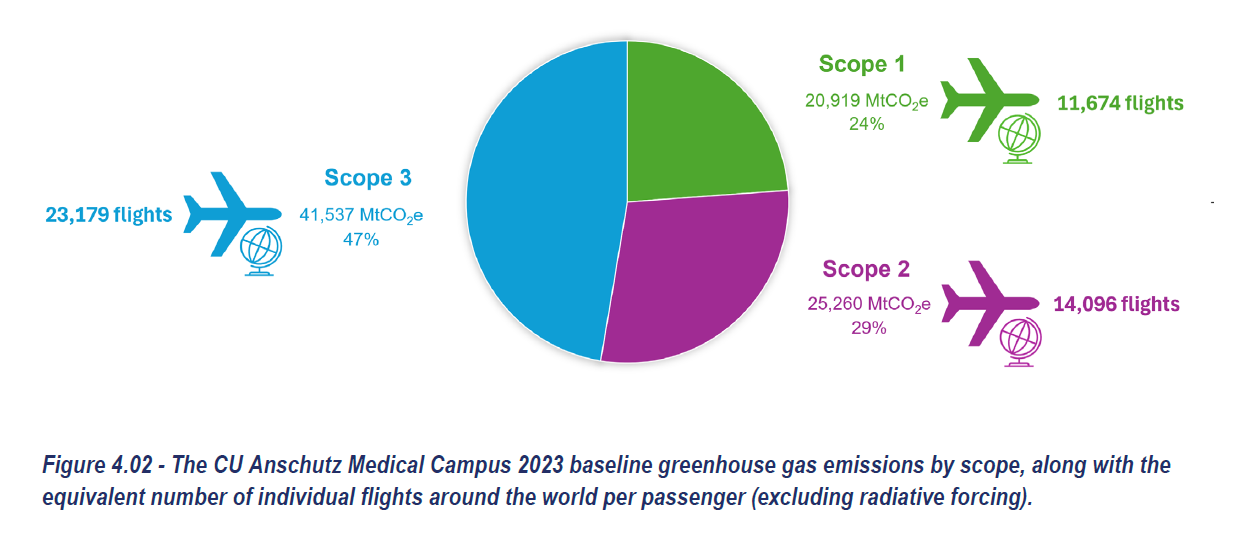
CU Anschutz has released its Climate Action Plan (CAP), marking a significant milestone in the campus’ ongoing commitment to sustainability. Designed to complement the existing Energy Master Plan (EMP), the CAP outlines a comprehensive strategy to achieve net zero greenhouse gas emissions by 2050.
This goal aligns with Colorado’s SB23-016, a state law mandating that public institutions reach net zero by 2050, with progress benchmarks set every five years.
While the EMP focuses on direct emissions, such as electricity and natural gas use, the CAP takes a broader approach. It addresses emissions from air travel, commuting, purchasing, waste, water use, campus culture, and more. As part of the planning process, baseline emissions were calculated across all three scopes:
- Scope 1 includes direct emissions from sources like stationary combustion, campus vehicle fuel use, and refrigerant leaks.
- Scope 2 covers indirect emissions from purchased electricity.
- Scope 3 encompasses all other indirect emissions, including those from procurement, waste disposal, business travel, and employee commuting.
One of the most striking findings: over 50% of CU Anschutz’s emissions fall under Scope 3. These emissions are often the most challenging to reduce, yet they are critical to address in any credible path to net zero. Air travel, commuting, and procurement of goods are the primary contributors in this category.
To set meaningful reduction targets, the CAP drew on benchmarks from industry leaders and peer institutions. For example, when establishing goals for reducing emissions from scientific equipment and supplies, the team analyzed data from CU Anschutz’s top vendors and leading global medical suppliers. These insights informed a series of five-year targets, culminating in a 90% emissions reduction by 2050. The aim of targeted reductions is ambitious yet achievable progress.
Community input played a central role in shaping the CAP. The planning process included three open town halls and three stakeholder meetings, where participants helped craft vision statements and provided feedback that directly influenced the plan’s direction.
Want to dive deeper? The full Climate Action Plan—including detailed initiatives and timelines—is available on our website. As we move forward, the CAP will serve as a guiding framework for climate action across campus, helping us build a more sustainable future together.