

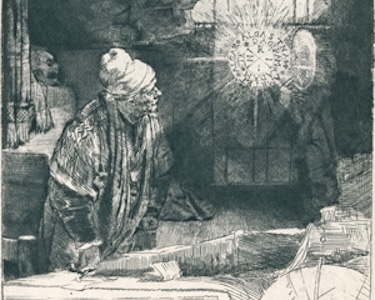
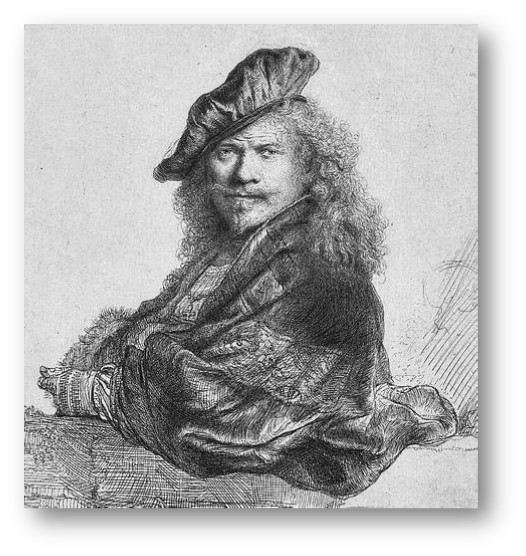
Rembrandt Harmenszoom van Rijn (1606-1669) is generally considered to be one of the greatest artists in Europe during what is called the Dutch Golden Age. Even for those familiar with his extraordinary achievements, it comes as a surprise that it was Rembrandt’s etchings – not his paintings – that were primarily responsible for the international reputation he enjoyed during his lifetime.
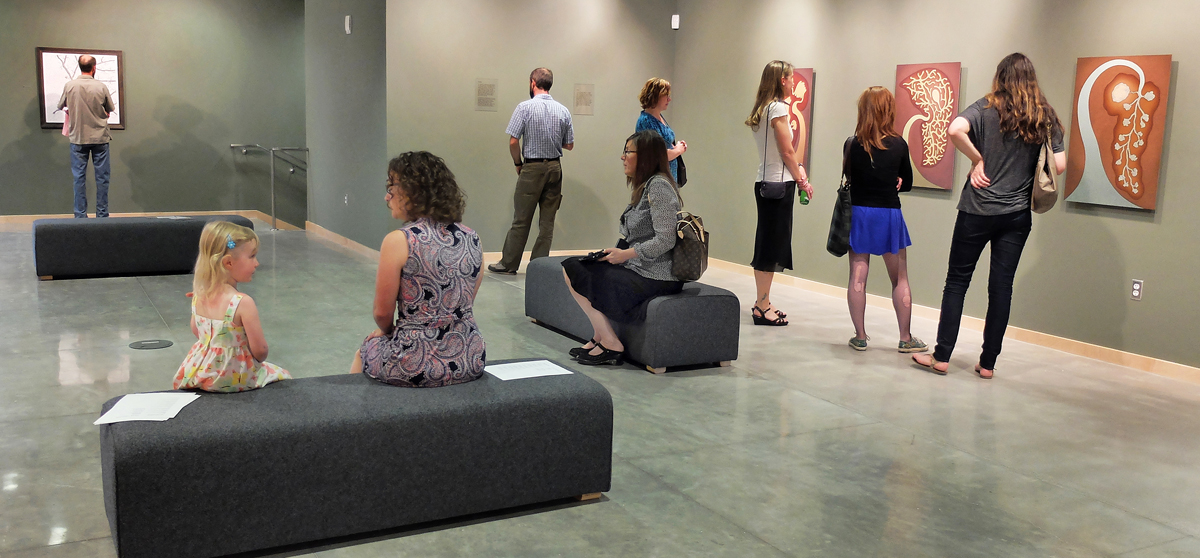
Rembrandt was a great experimenter, and his unsurpassed mastery of the relatively new medium pushed it to the expressive limits that continue to be reflected in the etchings of modern and contemporary artists. He was so superb an etcher that not a few critics and contemporaries were persuaded that he had discovered a “secret” process. Rembrandt continued to evolve as an etcher throughout his life, and this exhibit includes superlative examples from each period of his development as an artist and printmaker.Rembrandt: The Etchings is the second exhibition to come to The Art Gallery at the Fulginiti Pavilion for Bioethics and Humanities through the unstinting generosity of Tobia and Morton Mower. Their collection encompasses the artist’s entire life’s work in a medium that is central to his achievement. Unlike his best known paintings, the etchings are relatively small, and the intimate space of the Art Gallery makes them accessible for a closer look and for a renewed appreciation for his genius.
 Hours
HoursCU badged employees Monday-Friday 9am-5pm.
Open to the public Monday-Friday 11:30am-5pm.
Closed on federal holidays.
For more details please email [email protected]
Parking
The Center for Bioethics and Humanities and the gallery are in the Fulginiti Pavilion on the CU Anschutz Medical Campus, 13080 East 19th Avenue, Aurora, Colorado.
On-campus parking is $1/hour at the kiosks or with the Parkmobile app. To visit the gallery, park in the Georgetown lot.
CU Anschutz
Fulginiti Pavilion for Bioethics and Humanities
13080 East 19th Avenue
Administrative Office Room 201
Aurora, CO 80045
303-724-3994